
Solar Tracker Park, Ground-mounted Solar Park or Rooftop Solar Park — which suits your project?
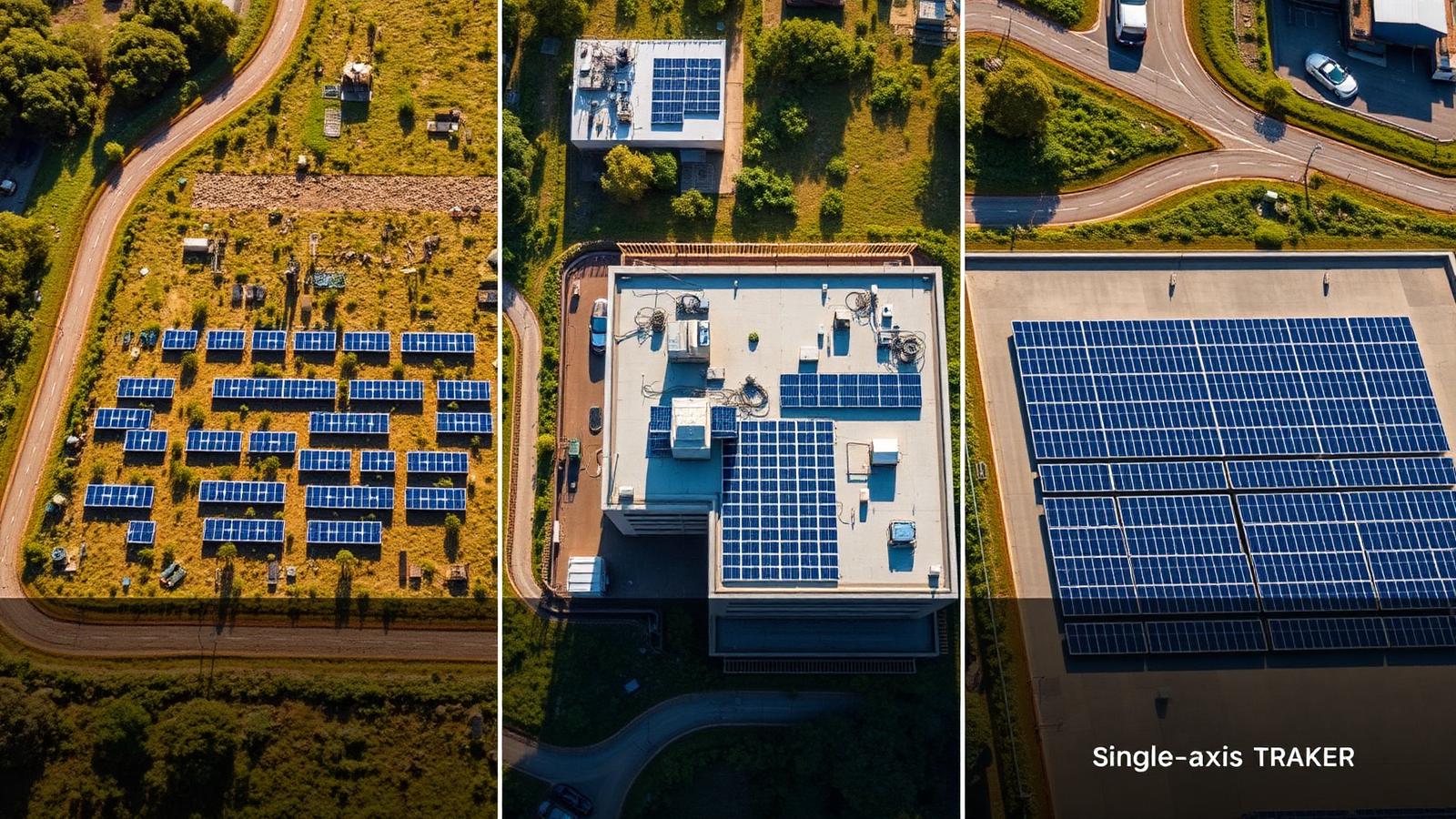
Choosing between a Solar Tracker Park, Ground-mounted Solar Park and Rooftop Solar Park depends primarily on land availability, grid connection capacity and expected yield, not just investment size.
Solar Tracker Park — maximum yield per area
Solar Tracker Parks use single-axis trackers that rotate panels east–west across the day. Yield is 15–25% higher than an equivalent fixed-tilt park, compensating for higher CAPEX and maintenance. HeilAres has participated in the installation of the 72.5 MW Stelpe ground-mounted solar park in Latvia.
Trackers suit large, flat sites where grid capacity does not limit output.
Ground-mount — maximum scalability
A ground-mount park is a fixed-tilt installation suited to large commercial and industrial-scale projects. A typical 1 MW ground-mount park requires 1–1.5 hectares of open land. CAPEX per watt is usually the lowest of the three types.
Ground-mount is preferred by developers with access to agricultural or industrial land who need large generation volumes within a fixed budget. Maintenance is simple, access is good and panel replacement is fast.
Rooftop — using existing surfaces without occupying new land
Rooftop parks suit owners of industrial buildings, warehouses, factories and distribution centres who want to reduce electricity costs and CO2 footprint without using ground area. A typical 1 MW rooftop park covers about 6 000–8 000 m² of roof.
Rooftop's advantage is on-site self-consumption — energy produced is used locally, giving especially fast payback in high-price environments. The prerequisite is that the load-bearing structure tolerates the added weight.
How to choose the right type?
First: is there a large open site available? If yes and grid allows, tracker is most productive. If land is constrained or expensive, rooftop is logical. Ground-mount fits when CAPEX is the priority and land is reasonably priced.